
Renewables manufacturing needs two things industrial land is uniquely good at supplying: uninterrupted floor area, and roof.
Floor area and clean assembly
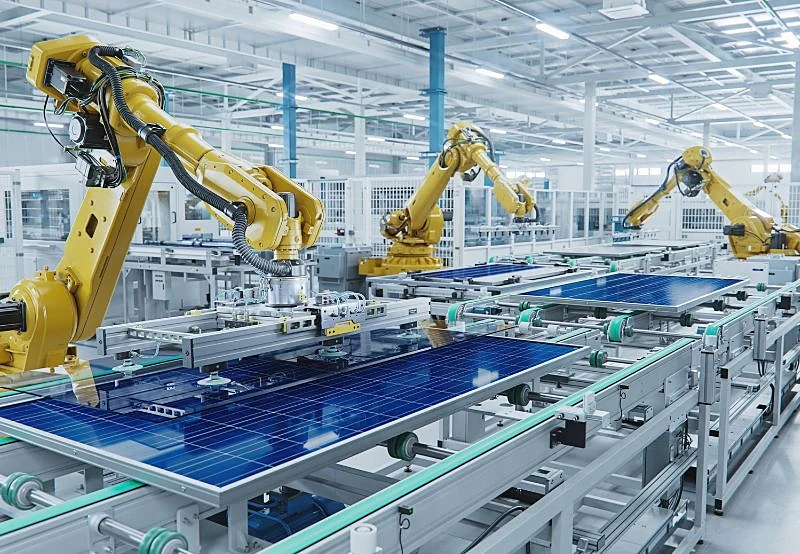
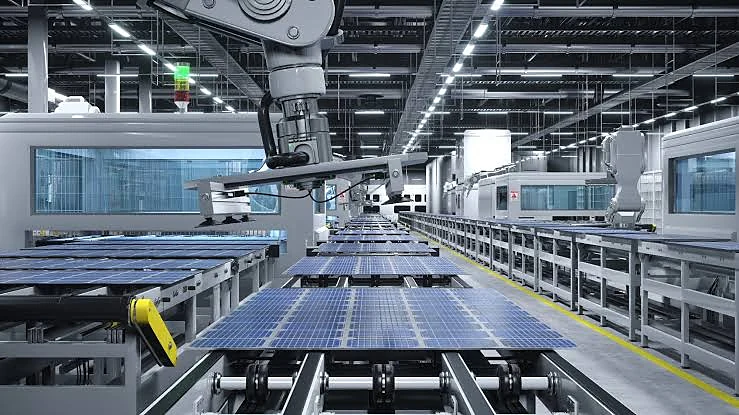
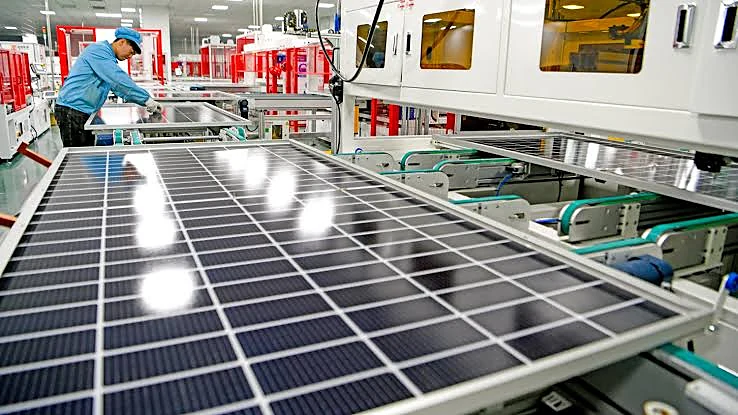
Module assembly, inverter and balance-of-system manufacturing, and mounting-structure fabrication are all comparatively space-hungry relative to their machinery weight. Long, clear, uninterrupted floor suits them.
Clear-span construction matters for the same reason it matters in fabrication: assembly lines want to run straight. Our sheds are pre-engineered clear-span steel at 8 metres clear height, which suits assembly work and the material handling around it.
Some processes — particularly module lamination and testing — carry cleanliness and environmental-control requirements that push toward built-to-suit, where the building can be drawn around the line.
India is now the world's third-largest renewables market
India's installed renewable capacity reached 282.75 GW including large hydro (230.78 GW excluding) as of May 2026, with solar at 162.15 GW (June 2026) and wind at 56.1 GW (April 2026). Non-fossil sources now account for 291 GW of 542 GW total capacity — 53.8%.
Renewable capacity has compounded at 16.84% CAGR between FY16 and FY26, and solar generation grew 21.23% year on year in FY26. India ranks third globally by installed renewable capacity, behind China (2,258.02 GW) and the United States (467.92 GW).
The stated target is 500 GW of non-fossil capacity by 2030. Whatever view you take on whether that is met, the manufacturing and assembly capacity implied by even partial delivery is substantial — and it needs industrial floor space with good power and roof area.
Why specification decides the outcome
The floor, the span and the power supply are the expensive things to change later. They are worth more scrutiny than the rent line.
Roof is an asset, not just a cover
A large industrial roof is a rooftop solar site. For a renewables manufacturer there is an obvious coherence in generating on your own roof, and for any manufacturer there is a straightforward economic case where the tariff and capital cost line up.
Haryana's industrial policy has included assistance toward rooftop solar installation alongside support for DG-set capacity. Treat that as a factor to verify with the department rather than a fixed entitlement, but it is worth building into the evaluation.
When assessing a shed, ask about roof structure and orientation if rooftop generation is part of your plan — the structure has to carry the array.
Storage and logistics characteristics
Finished modules are bulky, fragile and awkward to handle. Storage and despatch arrangements need more space and more care than the unit weight suggests.
Inbound material — glass, frames, cells, encapsulant — arrives in volume and often on long vehicles. Yard depth and turning provision matter accordingly.
Plan for the outbound peak. Renewables project supply tends to be lumpy, dispatching against project milestones rather than evenly.
Policy context, stated carefully
Renewable manufacturing sits in an actively supported policy environment at both central and state level. Haryana’s Progressive MSME & Export Promotion Policy 2026, notified 29 July 2026 in supersession of HEEP 2020, names Renewable Energy, Circular Economy & Green Industry — solar cell and panel manufacturing explicitly included — as one of its nine thrust sectors.
Incentive rates are set by the status of the land rather than the district. At the top Prime/Focus rate that is a 30% capital investment subsidy up to ₹4 crore, a 100% stamp duty refund, 70% of Net SGST reimbursed over seven years and 7% interest subsidy on term loans. The full schedule is here.
Policy support changes. Verify current terms and eligibility with the Department of Industries & Commerce, Haryana, or your advisor before committing capital on the strength of it.
| Measure | Figure | Period | Source |
|---|---|---|---|
| Total renewable capacity (incl. large hydro) | 282.75 GW | May 2026 | IBEF |
| Renewable capacity (excl. large hydro) | 230.78 GW | May 2026 | IBEF |
| Solar installed capacity | 162.15 GW | June 2026 | IBEF |
| Wind installed capacity | 56.1 GW | April 2026 | IBEF |
| Non-fossil share of total capacity | 291 GW of 542 GW (53.8%) | May 2026 | IBEF |
| Renewable capacity CAGR | 16.84% | FY16–FY26 | IBEF |
| Solar generation growth | 21.23% YoY | FY26 | IBEF |
| Non-fossil capacity target | 500 GW | by 2030 | IBEF |
| Global rank by renewable capacity | 3rd | Dec 2025 | IBEF |
| Haryana installed power capacity | 14,845.56 MW | Mar 2026 | IBEF |